

There is a particular frustration that hits furniture buyers during a move or a renovation — the sofa that fit perfectly in the last apartment has no reasonable place in the new living room. It is too long for one wall, too short for another, and the configuration was never meant to be changed. The only real option is to sell it and start over. Anabei was designed with that exact problem in mind.
Anabei is a direct-to-consumer furniture brand built under CABA Design, a company with substantial experience in manufacturing and product development. The brand’s sofa lineup is built on a modular system that allows buyers to select, expand, and reconfigure their seating without purchasing an entirely new piece of furniture. That flexibility is not an add-on feature, it is the structural premise of how the products are designed and sold.
Why Most Sofas Fail the Second Home Test
A standard sofa is a fixed object. It has a set length, a set configuration, and no meaningful capacity for change. Buyers select it based on the dimensions of their current space, and it performs well until the space changes. A growing family adds a room. A relocation brings a different floor plan. A home office conversion shrinks the living area. In each of these situations, the sofa becomes a problem the buyer has to solve with money.
The furniture industry has historically treated this as normal. Sofas are priced and marketed as long-term purchases, but their fixed nature means they have a functional lifespan tied to a specific room rather than to the buyer’s actual life. Replacement cycles that should be measured in decades end up compressed into five or six years simply because the product cannot adapt.
Flexibility Built Into the Frame
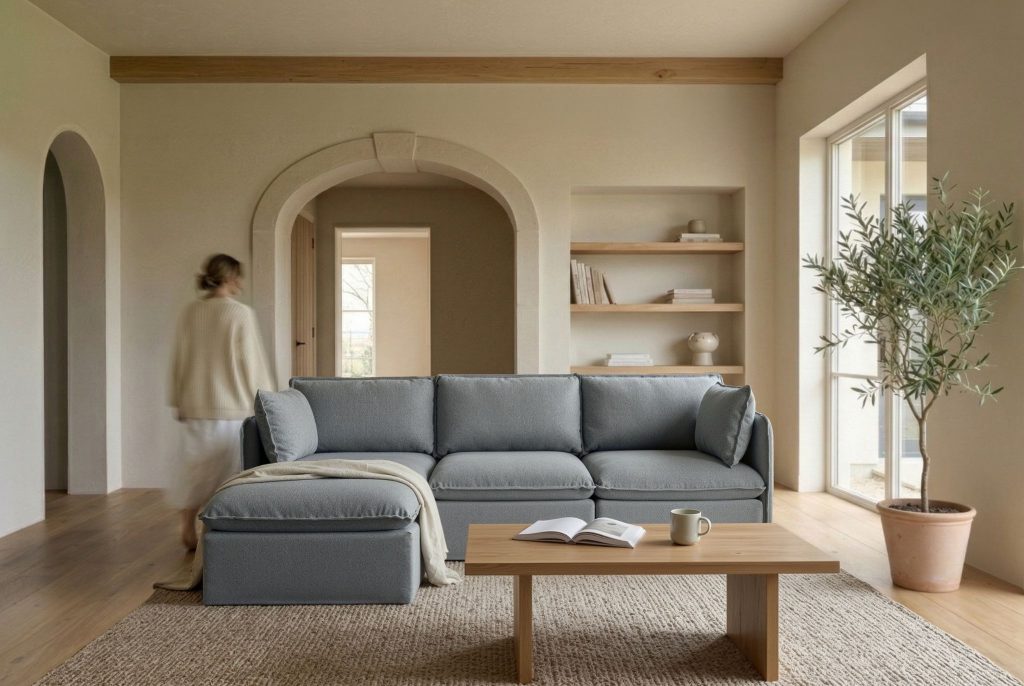
Anabei’s modular configuration system gives buyers direct control over the size and shape of their seating. Sections can be added to expand a two-seat arrangement into a sectional. Pieces can be removed or repositioned when a room layout changes. The system is designed so that reconfiguration does not require professional installation or specialized tools.
This matters most at the moment furniture typically fails buyers, during moves, renovations, or household changes. A modular sofa that can be broken down, transported in sections, and reassembled in a new configuration is functionally a different category of product than a fixed-frame sofa, even if the two look similar at the point of sale.
The Cost Argument for Modular Design
Replacing a sofa is expensive in ways that go beyond the purchase price. There is the cost of the new piece, the disposal or resale effort for the old one, and the time spent selecting and waiting for delivery of a replacement. For buyers who move frequently or anticipate household changes, those costs accumulate across a decade of ownership.
Anabei furniture is positioned as a long-term investment precisely because its modular system reduces the likelihood of forced replacement. A buyer who starts with a three-seat configuration can add sections as their household grows. A buyer who downsizes can remove sections rather than replacing the entire sofa. The product adapts to the buyer’s circumstances rather than requiring the buyer to adapt to the product.
Direct-to-Consumer Pricing and the Value Equation
Anabei operates on a direct-to-consumer model, which removes the traditional retail markup from the price. That pricing structure is relevant to the modular value argument because it changes the cost basis for adding sections over time. Expanding a modular configuration through a DTC brand carries a different price profile than purchasing add-on pieces through a traditional retail channel.
CABA Design’s manufacturing and supply chain experience supports faster lead times and more direct quality control than brands relying on third-party wholesale networks. For buyers adding to an existing configuration, consistency in materials, color, and construction across purchase dates is a practical concern, one that Anabei’s production model is structured to address.
What Buyers Should Evaluate Before Purchasing
A modular sofa system requires a different evaluation process than a standard sofa purchase. Buyers should consider not just the current room dimensions but the range of configurations the system supports and whether those configurations map to likely future needs. Anabei’s product lineup includes options across seating counts and layout types, with removable and machine-washable covers that carry through the full range of configurations.
The washable cover system and the modular frame work together in a way that extends the ownership argument. A sofa that can be reconfigured for a new space and fully cleaned on a regular schedule without professional service represents a meaningfully different ownership experience than what most furniture buyers have come to expect from the category.
About Anabei
Anabei is a direct-to-consumer furniture brand developed under CABA Design, specializing in modular sofa systems with fully removable and machine-washable covers. Built for families, pet owners, and homeowners who want furniture that adapts to their space over time, Anabei combines powder-coated steel frame construction with performance upholstery designed for long-term daily use. Learn more about Anabei and the full product range on the brand’s official website.